
Powerlifting: a complete guide for sports coaches
Powerlifting is one of the most technically demanding and clearly defined strength sports. Its competitive scene is governed by established federations, and the broader interest in structured strength training has grown steadily over the past decade. This guide covers the essentials of powerlifting, its training principles, programming logic, and what it takes to coach it effectively online.
What is powerlifting?
Powerlifting is a strength sport built around three movements: the squat, the bench press, and the deadlift. The goal is to lift the maximum possible load on each of these three exercises, within strict technical standards judged in competition. The final score, known as the total, is the sum of the best successful attempt on each lift.
The sport is governed by national and international federations, the most prominent being the International Powerlifting Federation (IPF). Competitions are organized by bodyweight category and gender, with additional age divisions (junior, open, masters). Two formats exist: equipped powerlifting, which allows supportive gear such as squat suits and bench shirts, and classic (raw) powerlifting, which limits equipment to knee sleeves, a belt, and wrist wraps.
Powerlifting emerged in the United States during the 1950s and 1960s from informal "odd lifts" practiced in gyms. It gained formal structure through the 1970s and 1980s as federations were established. Today, raw powerlifting in particular is experiencing significant growth, driven in part by the strength training community online.
The benefits of powerlifting
The primary benefit of powerlifting is the development of maximal strength. Systematic training on the squat, bench press, and deadlift with heavy loads and precise technique produces substantial strength gains that carry over to a wide range of physical activities. Muscle hypertrophy is a natural byproduct of this training, even when it is not the primary goal.
From a musculoskeletal health standpoint, heavy resistance training increases bone density, strengthens tendons and ligaments, and improves joint stability. These adaptations have documented preventive value, particularly for osteoporosis prevention. Functional strength gains also translate to improved daily physical capacity, especially in older populations.
Powerlifting also builds specific mental qualities: the ability to tolerate discomfort, composure under competitive pressure, and the patience required to progress over long training cycles. The objectivity of the sport (a total, measurable in kilograms, judged against clear standards) gives athletes a transparent and motivating framework for tracking progress.
Who is powerlifting for?
Powerlifting attracts a broader range of practitioners than is often assumed. Common profiles include:
- Recreational strength training enthusiasts who want a structured goal beyond general gym progress
- Competitive athletes targeting performance in sanctioned meets, from regional to international level
- Goal-oriented individuals who respond well to the clear framework the sport imposes (technical standards, progressive overload, periodized cycles)
- Masters lifters (40 and above) who find powerlifting a sustainable competitive outlet, with dedicated age categories in most federations
- Women seeking a structured, performance-focused strength discipline; female participation in powerlifting federations has grown considerably in recent years
The main contraindications involve unstabilized spinal pathologies (disc herniations, spondylolisthesis), certain cardiovascular conditions, and acute joint injuries to the knees, hips, or shoulders. A medical clearance is advisable for athletes with a relevant history before beginning heavy training.
Training fundamentals
Technical proficiency on the three competition lifts is the cornerstone of powerlifting coaching. Each movement has its own judging criteria in competition and its own biomechanical demands.
The squat
The powerlifting squat requires the hips to descend below the level of the knees (at or below parallel). The bar rests on the upper back, either in a high-bar or low-bar position. Key technical points include trunk bracing, torso angle management, knee tracking, and force transfer through the floor. The most common fault is the hips rising faster than the shoulders on the ascent, a "good morning" squat, typically indicating a weak posterior chain or an imbalanced load distribution.
The bench press
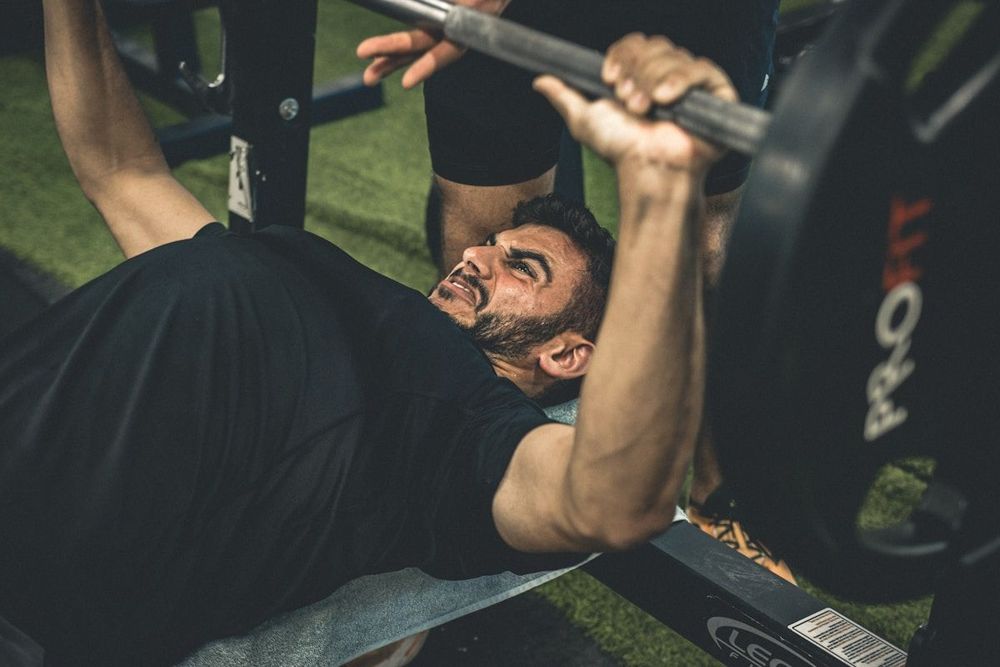
The powerlifting bench press requires a controlled touch of the bar to the chest and full arm extension at lockout, with the elbows fully pressed out. Foot position, back arch, scapular retraction, and bar path are critical technical variables. Grip width and thumb placement significantly influence bar trajectory and the balance of contribution between the pecs, shoulders, and triceps.
The deadlift
The deadlift is contested in two stances: conventional (feet hip-width apart, hands outside the legs) and sumo (wide stance, hands inside the legs). The starting position is the primary technical focus: flat back, neutral hips, bar in contact with the shins. A clean lift coordinates leg drive and back tension simultaneously; losing that tension during the pull is the most common cause of technical breakdown.
Equipment requirements
Raw powerlifting requires minimal but specific equipment.
The basic training setup includes:
- An Olympic barbell suitable for the loads being trained (competition-standard bars for athletes preparing to compete)
- Calibrated weight plates for accurate loading
- A squat rack or power cage with adjustable safeties
- A stable bench press bench with adjustable height
Competition-legal accessories in raw powerlifting include a lifting belt, knee sleeves, wrist wraps, and appropriate footwear (heeled shoes for the squat, flat soles or dedicated deadlift shoes for the pull). These accessories have a real performance impact, and a coach should be able to guide athletes on what to use and when to introduce each piece.
For clients training in commercial gyms, it is worth verifying upfront what equipment is available (bar types, rack quality, plate selection) to adapt the program accordingly rather than discovering limitations mid-cycle.
How is a program structured?
Powerlifting programming is built on well-established periodization principles, all oriented toward developing maximal strength across three specific movements.
Training frequency is a key variable. Most intermediate and advanced programs train each lift two to three times per week. This frequency allows for adequate technical volume and skill accumulation while managing central nervous system fatigue.
Session structure centers on the main competition lift of the day, followed by variations and targeted accessory work. A squat day might include competition-style squats, pause squats (with a deliberate hold at the bottom), and accessory exercises for the quads, hamstrings, and lower back.
Periodization in powerlifting typically follows a block model oriented toward a competition or a max-effort testing day:
- Accumulation phase: higher volume, moderate intensity (60-75% of maximum)
- Intensification phase: reduced volume, heavier loads (75-90%)
- Peak phase: low volume, near-maximal or maximal loads (90-100%)
- Deload: a recovery week before competition or testing
Progression models vary by level. Beginners respond well to simple linear progression. Intermediate and advanced athletes require more sophisticated approaches such as undulating periodization or block-based conjugate systems. The choice of model depends on the athlete's training age, competition frequency, and individual recovery capacity.
Online coaching opportunities
Powerlifting is well suited to remote coaching, with a few discipline-specific considerations worth understanding.
Programming is precise and fully documentable. Training variables (load, sets, reps, RPE or percentage of maximum) translate directly into a spreadsheet or training app. Coaches can track progression week over week and make adjustments remotely with a level of precision comparable to in-person coaching.
Video analysis is non-negotiable in online powerlifting coaching. Technical feedback relies almost entirely on video review. A coach must be able to identify faults in all three lifts from multiple angles (front, side). This skill is the core of the service and the main differentiator in this market.
Competition cycles create natural retention structures. A meet schedule organizes the coaching relationship across several months. Athletes preparing for a competition need consistent, ongoing support, which creates longer engagements and stronger coach-athlete relationships.
Powerlifters tend to research their training seriously, compare programs, and ask detailed questions. For a coach who can demonstrate programming knowledge and technical expertise, depth of knowledge builds credibility faster than marketing.
Key challenges in remote powerlifting coaching include assessing squat depth and hip position from video alone, which requires athletes to film from specific angles consistently. Managing central nervous system fatigue remotely, without the ability to observe the athlete directly, is another variable that requires open communication and experience to navigate well.
Related sports
Powerlifting shares its foundations with several strength and power disciplines:
- Bodybuilding uses the same foundational movements but pursues aesthetic development rather than maximal strength. Many lifters cycle between powerlifting-style training (to build load capacity) and bodybuilding-style training (for hypertrophy), and coaches with both backgrounds can serve a broader clientele.
- Olympic weightlifting is another platform-based strength sport, centered on the snatch and the clean-and-jerk. It demands greater explosiveness and mobility than powerlifting, but both sports share a culture of technical rigor and structured progression.
- Strongman tests strength across a wide variety of events: atlas stones, farmer's carries, log press, vehicle pulls. The general strength base developed in powerlifting transfers well to most strongman events, and athlete crossover between the two disciplines is common.
- Streetlifting is a hybrid discipline combining powerlifting movements (squat, bench press) with weighted bodyweight exercises (weighted pull-ups and dips). It has grown steadily among athletes who want to combine absolute strength with relative strength, and it attracts a younger competitive demographic.
FAQ
Do you need to compete to practice powerlifting?
No. Powerlifting-style training is widely practiced without any competitive intent. Many athletes follow powerlifting programs purely to build strength, with no plans to enter a meet. Competition is optional, but it provides a concrete testing environment and a motivating structure for those who choose to pursue it.
What is the difference between raw and equipped powerlifting?
Raw (classic) powerlifting restricts equipment to a belt, knee sleeves, and wrist wraps. Equipped powerlifting additionally allows a squat suit, a bench shirt, and a deadlift suit. These garments allow lifters to move significantly heavier loads but require their own specialized technique to use effectively.
Is powerlifting appropriate for beginners?
Yes, when introduced with appropriate load management and a focus on technique from the outset. Beginners progress quickly in powerlifting thanks to simple linear progression models. Coaching support early in the process is particularly valuable for establishing correct movement patterns before bad habits become ingrained.
Is powerlifting hard on the lower back?
As with any strength sport, injury risk exists. However, when trained with sound technique and a sensible progression rate, powerlifting reinforces the posterior chain and can contribute to improved lumbar health. Most back injuries in powerlifting result from repeated technical errors, excessive load progression, or inadequate recovery, not from the sport itself when practiced responsibly.
Conclusion
Powerlifting is a technically rigorous, precisely structured strength sport with a clear performance framework. For a coach working online, programming quality and technical precision are the primary differentiators. The discipline adapts well to remote coaching, provided the coach has solid video analysis skills and experience with strength periodization.